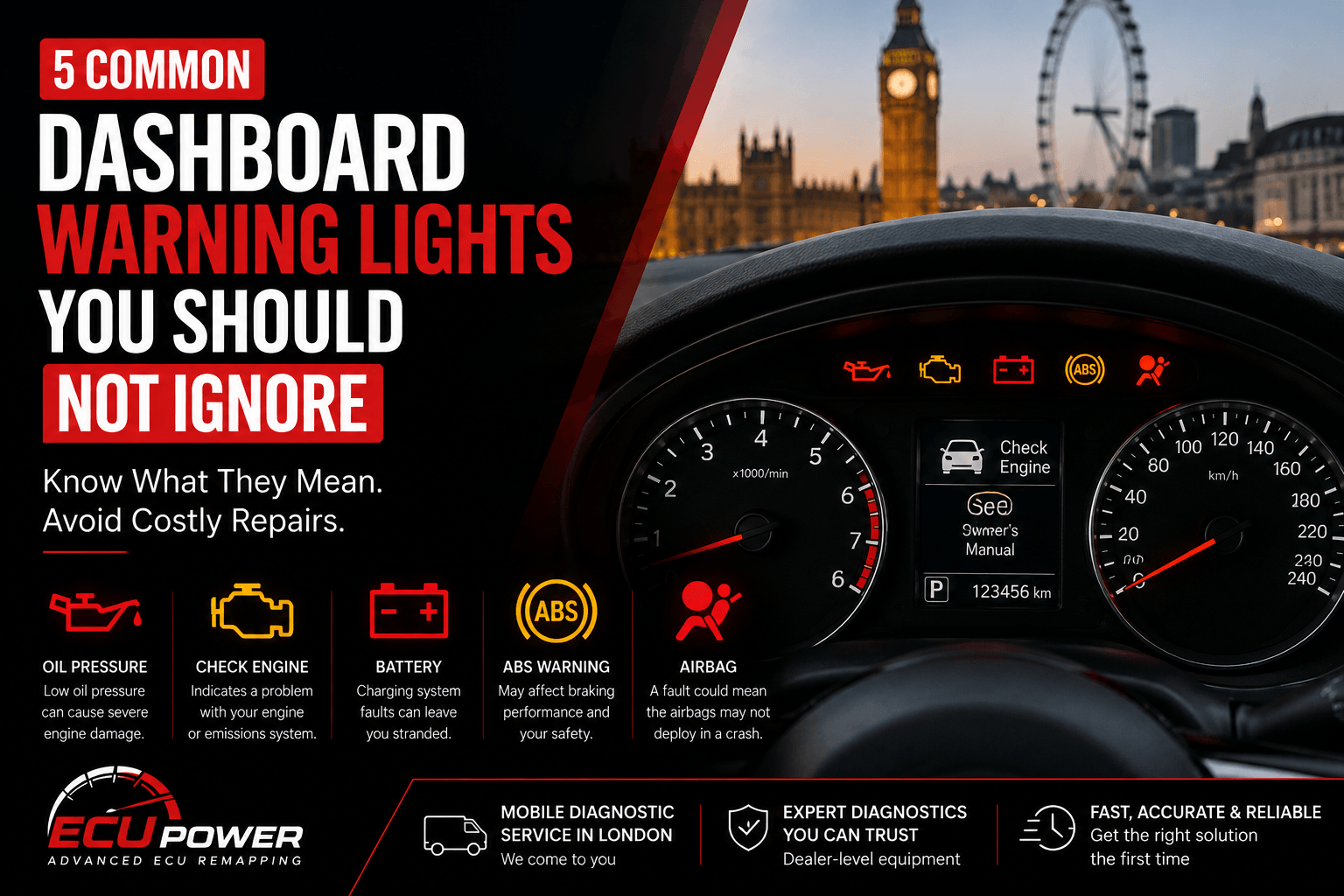
A warning light appearing on your dashboard can be unsettling, especially when you are not sure whether it is safe to continue driving. Modern vehicles use electronic systems and sensors to monitor many parts of the car, so a warning light can point to anything from a system notification to a fault that needs prompt attention.
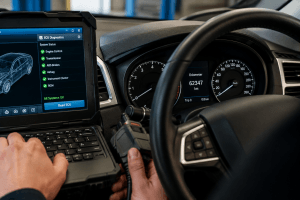
Understanding the general meaning of a warning light is useful, but the symbol alone does not always identify the underlying problem. A diagnostic scan can provide more information about stored or active fault codes and help a technician investigate the cause. If you are looking for mobile car diagnostics in London, ECU Power provides a convenient service across London and surrounding areas.
What Do Dashboard Warning Light Colours Mean?
Warning-light colours generally give an indication of urgency, although the exact meaning can vary by manufacturer. National Highways explains the general traffic-light approach: red warnings call for immediate attention, amber warnings indicate that the vehicle should be checked as soon as it is safe to do so, while green, white or blue indicators are generally informational. Always check your vehicle handbook for the manufacturer’s specific guidance.
A light that briefly appears when you switch the ignition on can be part of the vehicle’s normal system check. The concern is usually when a warning remains illuminated, appears while driving, flashes unexpectedly or is accompanied by changes in vehicle behaviour.
1. Engine Management or Check Engine Light
The engine warning light can be triggered by a wide range of issues, from sensor or emissions-related faults to more significant engine or electronic problems. The light does not tell you the exact cause by itself, which is why a diagnostic scan can be useful when it remains on. If the light is flashing or the vehicle is running poorly, seek professional advice promptly rather than assuming it is safe to continue.
2. ABS Warning Light
An ABS warning light can indicate a fault within the anti-lock braking system. Because ABS is a safety system, a persistent warning should be investigated rather than ignored. Your normal braking may still operate in some circumstances, but the anti-lock function may not be available as intended.
3. Airbag or SRS Warning Light
An airbag or SRS warning light can indicate a problem with part of the vehicle’s restraint system. If the warning remains illuminated after the vehicle has started, professional inspection is advisable because the system may not operate as intended in a collision.
4. Battery or Charging System Warning Light
A battery-shaped warning light can indicate a charging-system problem rather than simply a weak battery. Potential causes can include the alternator, electrical connections, wiring or the battery itself. If the warning remains on while the engine is running, the vehicle may eventually lose electrical power, so it should be checked promptly.
5. Oil Pressure or Engine Temperature Warning Light
Oil-pressure and engine-temperature warnings can indicate potentially serious conditions. If either warning appears while driving, follow the vehicle manufacturer’s instructions and stop safely when appropriate. Continuing to operate an overheating engine or a vehicle with an oil-pressure problem can cause significant damage.
When Should You Get a Diagnostic Check?
A warning light is a reason to investigate, but the urgency depends on the symbol, colour, vehicle symptoms and manufacturer’s instructions. A professional diagnostic check can be particularly useful when:
A warning light stays on after starting the vehicle.
A warning appears repeatedly or returns after being cleared.
The vehicle develops unusual performance, starting or electrical symptoms.
Several warning lights appear at the same time.
You have recently had a repair, battery replacement or electronic component replaced.
You have a fault code but are unsure what it means.
Why a Diagnostic Scan Is Better Than Simply Clearing a Warning Light
Clearing a fault code can remove a warning from the dashboard temporarily, but it does not necessarily repair the cause. If the underlying issue remains, the warning may return. A proper diagnostic process looks at the available fault information and the vehicle’s symptoms before deciding whether a reset, repair or further investigation is appropriate.
ECU Power’s Diagnostic Reset & Repair service is designed to identify fault codes and electronic issues, then carry out an appropriate reset or repair where applicable.
Can You Drive With a Dashboard Warning Light On?
There is no single answer because different warning lights have different levels of urgency. A red safety-related warning generally requires immediate action, while an amber warning may allow you to continue carefully to a safe location or arrange professional assistance, depending on the vehicle and the manufacturer’s guidance. citeturn0search24turn0search1
If a warning is accompanied by smoke, overheating, loss of braking, severe loss of power, unusual noises or other serious symptoms, do not rely on the warning light alone. Follow your vehicle handbook and seek appropriate roadside or professional assistance.
Mobile Car Diagnostics in London
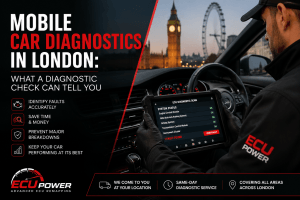
For drivers in London and surrounding areas, a mobile diagnostic service can be a convenient way to investigate electronic faults without making an unnecessary journey to a workshop. ECU Power provides mobile diagnostic assistance at suitable customer locations, including home or work appointments depending on the vehicle and fault.
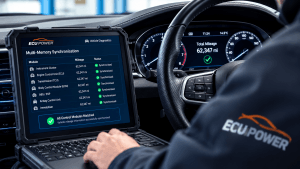
If the issue involves stored mileage information following legitimate electronic repairs or component replacement, ECU Power also provides Odometer Recalibration. Where several electronic modules need to remain consistent, Multi-Memory Synchronisation may also be relevant.
Frequently Asked Questions
What is the most serious dashboard warning light?
The seriousness depends on the vehicle and warning. Red warnings associated with brakes, oil pressure, overheating or other safety-critical systems can require immediate action. Always check the owner’s manual and follow the manufacturer’s instructions.
Can a diagnostic scan tell me why a warning light is on?
A diagnostic scan can identify stored or active fault information from the vehicle’s electronic systems. The code still needs to be interpreted alongside the vehicle’s symptoms to determine the likely cause.
Can you reset a dashboard warning light?
A warning can sometimes be reset after the underlying issue has been addressed, but simply clearing a code does not necessarily repair the fault. The appropriate process depends on what caused the warning.
Do you offer mobile diagnostics in London?
ECU Power provides a mobile diagnostic service across London and surrounding areas, subject to the vehicle, fault and location being suitable for on-site work.
Should I ignore an amber warning light?
No. Amber generally indicates that attention is required, even when it may not require an immediate stop. Check your vehicle handbook and arrange appropriate inspection or diagnosis.
Final Thoughts
Dashboard warning lights are designed to alert you when a vehicle system needs attention. Understanding the colour and symbol can help you judge the urgency, but a warning light does not always reveal the underlying cause. Professional diagnostics can provide useful fault information and help determine the appropriate next step.
If your vehicle is showing a persistent warning light and you need mobile car diagnostics in London or the surrounding areas, ECU Power can assess the fault using professional diagnostic equipment and advise on the appropriate solution.